The Honest Answer: It Depends on Three Things
Salesforce is not for every small business. It is powerful, flexible, and the world's number one CRM — but it is also expensive and complex. Here is how to know if it is worth it for your specific situation.
When Salesforce IS Worth It for Small Business
You have a real sales process with multiple stages. If a deal takes more than one conversation to close and you have steps like discovery, demo, proposal, and negotiation, Salesforce will organize and accelerate that process significantly.
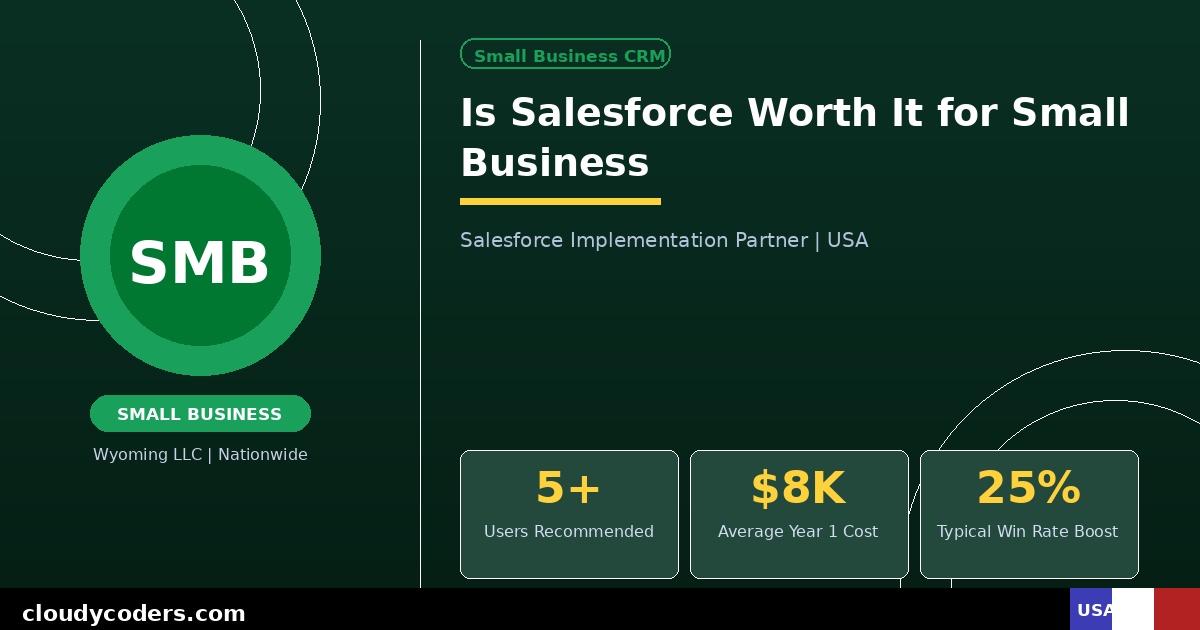
You have 5 or more salespeople. Below 5 reps, simpler tools like HubSpot or Pipedrive are usually sufficient and much cheaper. At 5+ reps, Salesforce pays for itself through better pipeline management and forecasting.
You plan to grow significantly in the next 2-3 years. Salesforce scales infinitely. If you go from 10 reps to 50, Salesforce grows with you. Cheaper CRMs often hit walls that require painful migrations later.
You need to integrate with other systems. If you need your CRM to talk to your ERP, accounting software, marketing platform, or custom systems, Salesforce has more integration options than any other CRM.
You are in a regulated industry. Healthcare, financial services, and legal sectors often need Salesforce specifically for HIPAA compliance, SEC record keeping, or other regulatory requirements.
When Salesforce Is NOT Worth It for Small Business
You have fewer than 5 users and simple sales. HubSpot CRM (free), Pipedrive ($15/user/month), or Zoho CRM ($14/user/month) will serve you well for a fraction of the cost.
Your sales process is transactional. If customers buy quickly with no sales conversation needed, you do not need a sophisticated CRM. An e-commerce platform or simple contact tracker is enough.
You cannot commit to proper implementation and training. Salesforce done badly is worse than no CRM. If you cannot invest in setup and training, start with a simpler tool.
Your budget is under $5,000 total for year one. Salesforce licenses plus implementation will realistically cost $8,000-$15,000 in year one for a small team. If that budget does not exist, Zoho or HubSpot are better starting points.
Real Cost for a Small Business in 2026
Here is a realistic budget for a 5-person sales team:
- Salesforce Essentials licenses: $25/user x 5 x 12 = $1,500/year
- Implementation (QuickStart package): $4,000-$6,000 one-time
- Basic integrations (email, calendar): included
- Training: included in implementation
- Year 1 Total: $5,500 to $7,500
- Year 2+: $1,500/year in licenses only
What You Get for That Investment
- Every lead tracked from source to close, nothing forgotten
- Sales pipeline visible to you and your team at all times
- Automated follow-ups so deals never go cold
- Revenue forecasts you can actually trust
- A platform that grows with your business for the next 10 years
Alternatives to Consider First
HubSpot CRM: Free tier is genuinely useful for up to 5 users. Paid tiers start at $50/month. Best for companies doing inbound marketing alongside sales.
Pipedrive: $15-$70/user/month. Extremely simple and visual. Best for small B2B sales teams with straightforward pipeline management needs.
Zoho CRM: $14-$52/user/month. Good Salesforce alternative at lower cost. We implement Zoho as well for clients who do not need Salesforce's full capabilities.
Our Recommendation
If you have 5 or more salespeople, a multi-step sales process, and plans to grow, Salesforce is worth it. The ROI from closed deals you would otherwise lose pays for the system quickly.
If you are below that threshold, start with HubSpot or Zoho and graduate to Salesforce when you outgrow them. There is no shame in starting smaller — it is actually smarter.
Not sure which applies to you? Book a free 20-minute call. We will tell you honestly whether you need Salesforce or whether a cheaper tool makes more sense right now.